Blog
Insights
The Benefits of Adding an Online Store to your Buy / Sell / Trade or Consignment Business
Grow your sneaker store with ecommerce. Reach more buyers, build trust, and manage inventory easily with Shopify integrations.
Tristan Tsvetanov
Owner & Operator
Mar 27, 2026
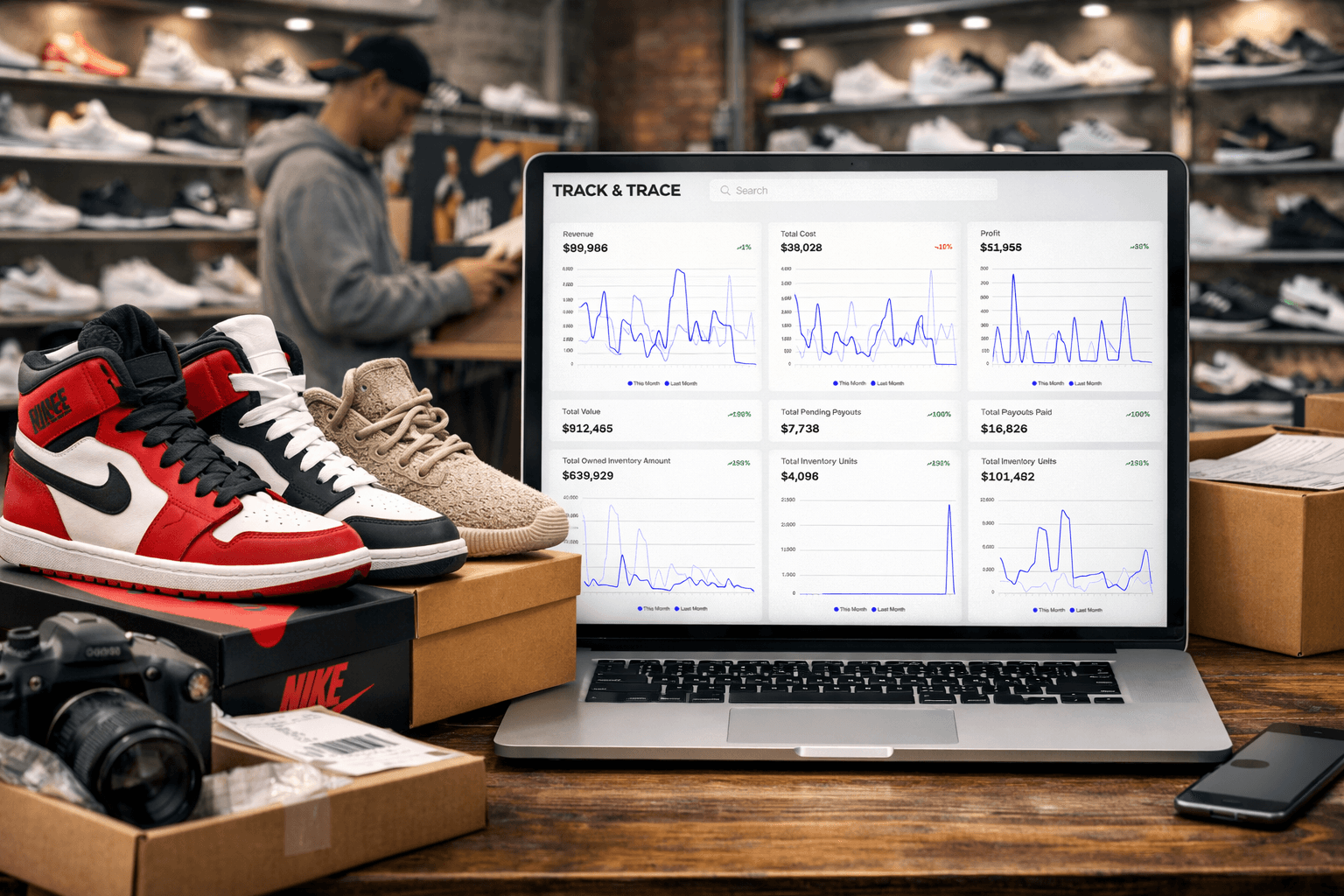
Nothing can beat the experience of shopping at a sneaker store in person, particularly in the buy / sell / trade and consignment context, where shoppers can hold, examine, and try sneakers they may have never actually seen in person before. For store owners however, relying only on foot traffic means leaving money on the table. Ecommerce accounted for 17% of total US retail sales at the end of 2025, up from about 11% in 2019. In other words, if you do not have an online presence, you are missing six more sales out of every hundred than you used to capture only a few years ago. This trend is not slowing down by any means: online resale and consignment sales grew 1.5x faster than the overall market in 2024, meaning that the mix of online shoppers is only growing. These figures also do not account for the customers who find inventory online before going in store to buy items in-person.
Altogether, stores that are not digitally shoppable are closed off to a meaningful share of potential customers and sales channels. They also come off as less credible to customers who want to browse and evaluate inventory online before going in person. We break this down more below and explain that, while the process to sell online feels daunting, it has become quite easy for stores to add an online channel.
Reach More Buyers
Physical stores are limited by geography. Even a great business with loyal local customers can only serve the people who walk in. An online store makes inventory purchasable anywhere, which matters given today’s shoppers increasingly start online, even when they eventually buy in-person. One 2026 roundup of consumer shopping research found that 86% of shoppers begin product research online. For buy / sell / trade and consignment stores selling unique items, that behavior is important given customers may not even know a particular type of inventory you carry exists, let alone know you have it in inventory, unless you can show it to them online first. Trace customers with online stores drive meaningful sales from cities and countries far away from where their nearest in-person stores exist. This also opens a much deeper pool of sellers and consignors, who can mail their products directly to purchasers, letting you make profits on items that may never come into your possession physically.
Build Store Credibility
Store websites also build customer trust. In an age of AI and low / no code products, it has never been easier to set up an online presence, and customers increasingly expect trustworthy stores to have made the effort. For buy / sell / trade and consignment stores, credibility is especially important given shoppers often have questions about authenticity before buying.
A good website signals vendors are reachable and permanent. It also helps make that the case by centralizing key support numbers and emails, and any other information that customers can refer to should they have any questions or concerns. Online stores are effectively a publicly viewable legit check on stores.
Setting up Your Store
For most stores, the easiest path is using an ecommerce platform that already handles hosting, design templates, checkout, payments, and inventory management. Shopify is one of the most common options because it is designed for merchants without deep technical experience.
While getting a website set up can be straightforward, building the requisite infrastructure to sell online can feel daunting. When polling Trace customers, the biggest cause for hesitation when they were deciding to build an online store was a lack of familiarity with platforms like Shopify, and a lack of features that it offered for the unique difficulties associated with buy / sell / trade and consignment like one-off inventory and item-level tracking between store owned and consignor owned products.
Trace helps solve these problems, and problems that plague in-store sales, by integrating with Shopify stores. Among other features, Trace allows customers to:
Enter different prices for the same SKU, giving owners optionality depending on condition, size, and the payout desired by consignors
Manage in-store and online only consigners through the online portal
Track payouts by consignor without employees having to manually check who is owed what at the time of sale
Integrate into key sales channels like TikTok shop to further boost store sales
Track and prioritize store owned vs. consignor owned inventory
Conclusion
Adding an online store is no longer just a nice extra for buy / sell / trade and consignment businesses. It is quickly becoming a core part of how stores reach customers, build trust, and grow sales. While setting up an online store can seem intimidating at first, the tools to get started are more accessible than ever, and the financial upside is worth the effort.
There are unique challenges for stores in this space like handling one-off inventory, consignor payouts, item-level tracking, and multiple sales channels. Trace helps eliminate any friction work by pairing the reach of Shopify with workflows built specifically for buy / sell / trade and consignment. The result is a simpler path to selling online, stronger day-to-day operations, and more opportunities to grow sales beyond the limits of foot traffic alone. Learn more about how trace can help bridge the gap for your Shopify store and help you start earning more here.